
AI-NATIVE RESEARCH & DECISION WORKSPACE
LUNARTULIP RESEARCH DESK / THEMATIC INVESTMENT INTELLIGENCE
See what changed faster—
and which judgments need updating.
LunarTulip Research Desk is an always-on thematic investment intelligence service for AI technology, continuously maintaining investment-relevant evidence, thesis states and signals across a focused set of themes, with delivery through institutional research subscriptions and machine-readable thematic data APIs.
Continuously operating · Human judgment in loop · Evidence traceable
RESEARCH DESK / TODAY SYSTEM PULSE · NOMINAL
DAILY RESEARCH STATEToday’s research priorities
01HIGH SIGNALTO VERIFY
Are upstream constraints changing the realization timeline?
Three new evidence items linked to the core thesis; next validation point updated.
THESIS UPDATEStrengthened / confidence bound unchanged+03
CHANGE LEDGERIndustry event causally tagged+07
NEXT ACTIONAwait operating-data cross-check48H
CURRENT ACTIVE COVERAGE / 8 TRACKS
Eight maintained themes across the AI technology value chain.
Coverage Tracks are stable taxonomy anchors. Research priority, available fields and delivery depth vary by theme and engagement scope.
30-SECOND SYSTEM VIEW / 01
Two research engines form continuous judgment in one workspace.
Discretionary fundamental research explains industries and companies; systematic quant tests signals and portfolio discipline. Research Desk connects both into a continuous experience from change detection and judgment updates to outcome learning.
01 / RESEARCH
Global information, industry causality and investment theses
Continuously ingest public information and organize companies, value chains, evidence and falsifiable theses in one research state.02 / STRATEGY
Factor research, backtests, stress tests and market regimes
The systematic quant engine tests signals, allocation rules and failure boundaries—independent validation without replacing the PM.03 / PORTFOLIO
Portfolio state, risk budgets, constraints and monitoring
Translate judgment into constrained portfolio expression while monitoring concentration, regimes, risk boundaries and outcome paths.04 / LEARNING
Decision memory, attribution and rule updates
Preserve point-in-time information and outcomes, then feed governed attribution back into the next research and decision cycle.ENGINE 01 / DISCRETIONARY FUNDAMENTAL
Discretionary fundamental system
Driven by PM judgment, using Coverage, the R-line AlphaMap × Ontology, industry causality, evidence and HYP lifecycles to continuously update company and industry views.HUMAN-LED RESEARCHENGINE 02 / SYSTEMATIC QUANT
Systematic quant system
Mostly automated. QuantLab continuously runs factor and model research, backtesting, allocation and systematic portfolio updates.SYSTEMATIC VALIDATIONRESEARCH WORKSPACE
Always-On Research Desk
Connects both engines’ research state, discretionary and quant NAV curves, outcome ledgers and reviewable decision memory across seven workspaces.CONTINUOUS RESEARCH WORKSPACEDELIVERY SURFACES / 02
One research state, delivered to people, agents and systematic workflows.
The public site preserves citable AlphaMap and Deep Dive articles. Professional and institutional clients can receive continuously updated human-readable research, a licensed Research API or point-in-time alternative datasets by coverage.
01 / HUMAN
Human-readable Research Desk
State Change Briefs, Coverage Reviews, Deep Dives, Research Models and limited Briefings.02 / MACHINE
Machine-readable Research API
Research Objects, claims, evidence, versions and falsifiers for internal agents and knowledge bases.03 / QUANT
Alternative datasets
Point-in-time thesis, event, state and candidate-factor data for systematic and quantamental buy-side teams.WORKSPACE IN PRACTICE / 03
Seven workspaces turn research state into daily action.
Today, Change Ledger, Coverage, Hypotheses, Decision Memory, Briefs and System Pulse organize priorities, change, coverage, theses, learning, output and operating state. The interfaces below are sanitized views of the working product.
ALWAYS-ON RESEARCH DESKWORKSPACE PREVIEW
TODAYHYPOTHESESCHANGE LEDGER

01 / TODAYToday’s research priorities
Compress daily change into research priorities, belief updates and the next validation actions.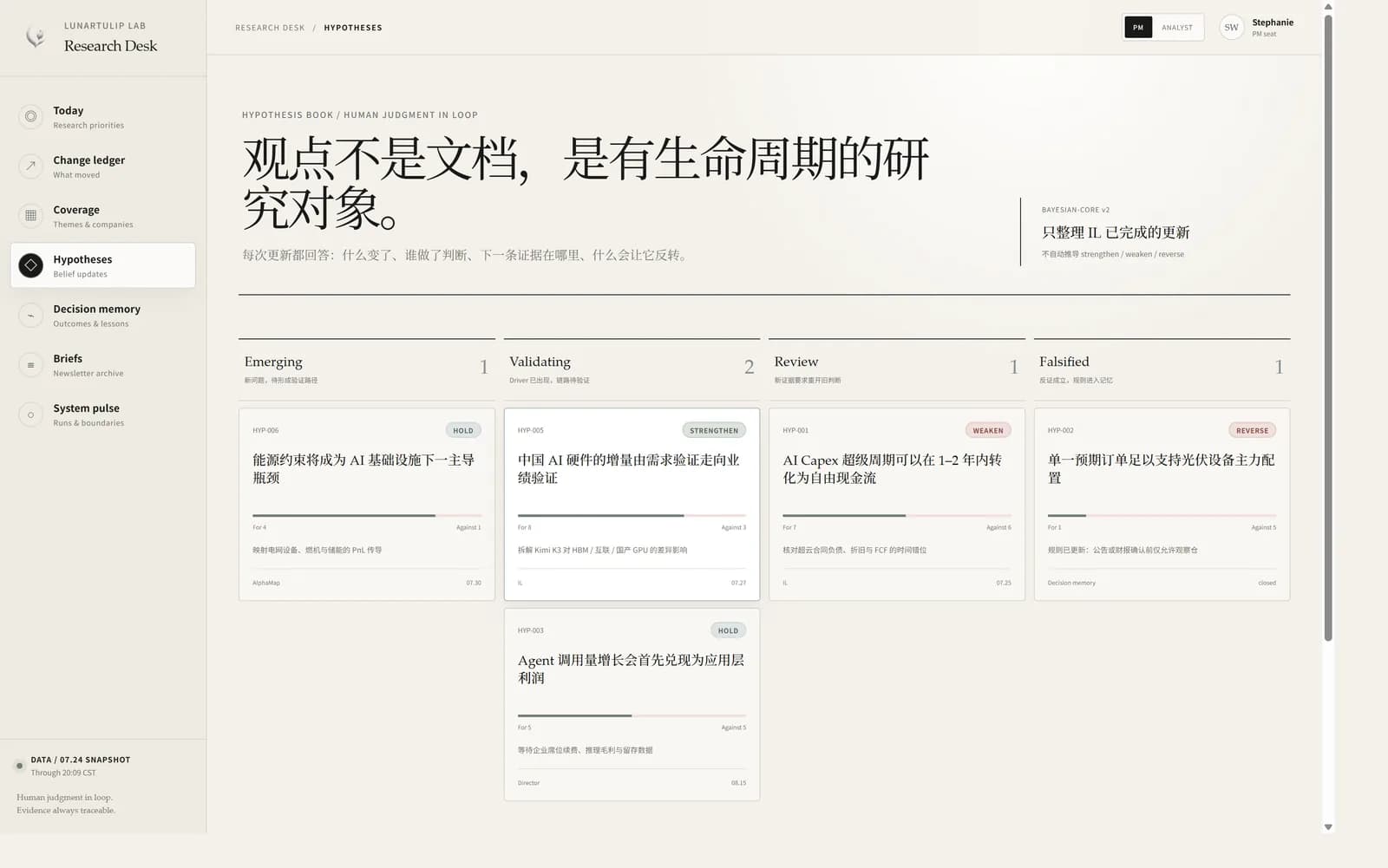
02 / HYPOTHESESHypothesis lifecycle board
Track strengthening, weakening, reversal and pending validation points.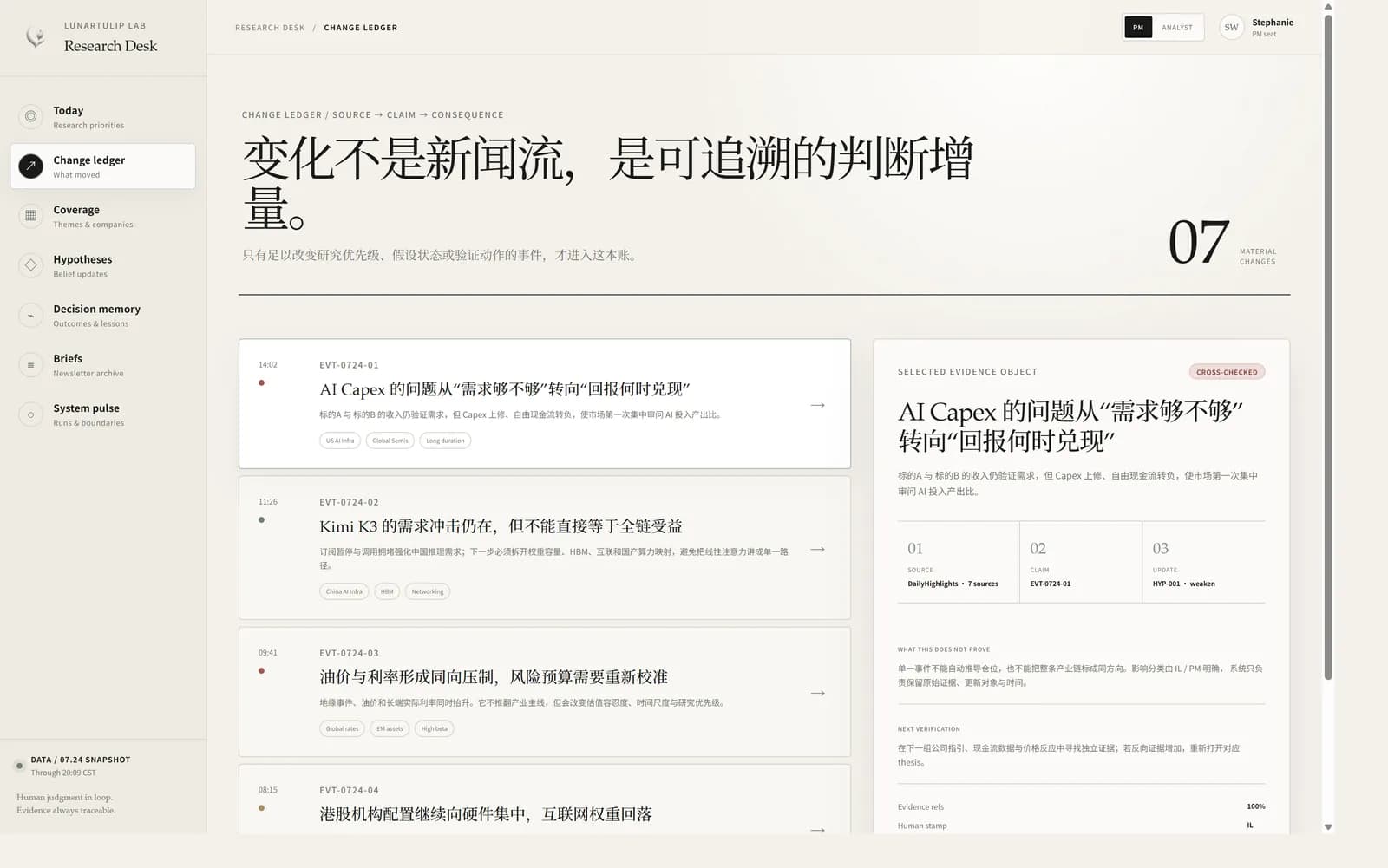
03 / CHANGE LEDGERTraceable event ledger
Connect each change to its thesis, evidence and next action.SANITIZED DEMONSTRATIONNO LIVE PORTFOLIO DATAEVIDENCE TRACE ENABLED
OPERATING LOOP / 04
Two research engines enter one learning loop.
NINE-LAYER ARCHITECTURE / 05
See how judgment forms, gets tested and improves from information to feedback.
Nine layers cover information intake, evidence and industry causality, theses, strategy discovery, quantitative validation, portfolio constraints, outcome attribution and decision memory. Each layer identifies its primary engine and operating mode, making the division between human judgment and system discipline clear.
AVAILABLE FOR EVALUATION
System architecture, sanitized interfaces, research samples, aggregate validation and correctionsPROTECTED INSTITUTIONAL ASSETS
Live positions, model weights, original calls, execution details and core decision memoryDEEPER VERIFICATION / 06
Begin with the research, then explore the system behind it.
Begin with a public AlphaMap sample or Deep Dive, then evaluate the Research Desk, licensed Research API or alternative datasets as needed. Public articles are for reading and citation; they are not licensed datasets.
RESEARCH METHODOLOGY / IMPORTANT INFORMATION
This page presents research methods, system architecture and sanitized interfaces to explain Lunartulip’s research capabilities and working approach. It is not investment advice, fundraising, financial-product solicitation or a promise of returns.